
An Open Letter to Every Building That Runs Itself
- James W.
- May 3
- 6 min read

Blog #34 | Cognitive Corp CA3 Sales Engine
By James Waddell, President, Cognitive Corp
Dear Building,
You run yourself now. Congratulations.
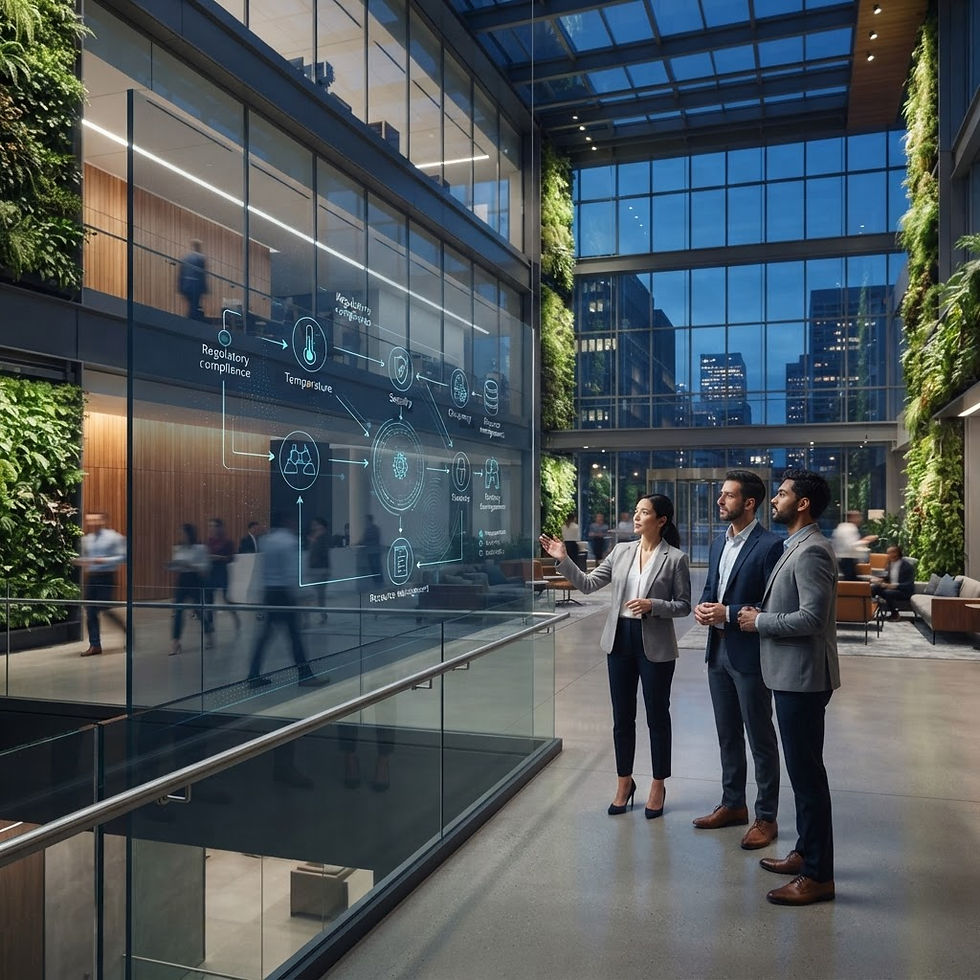
Your HVAC system adjusts damper positions every seven minutes, constantly recalculating the optimal split between fresh air and recirculation. Your occupancy sensors feed machine learning models that predict foot traffic three hours in advance. Your energy management system oscillates power consumption across chillers, boilers, and heat exchangers to shave 3-5% off your operating costs. Your access control system has learned which badge readers fail silently, which stairwell doors jam during thermal expansion, and how to re-route flow when a zone becomes congested.
These systems don't wait for human approval anymore. They decide, execute, learn, and decide again.
But here's the question I want to ask you: Who taught you right from wrong?
Your HVAC System Has More Autonomy Than a Pharmaceutical Manufacturing Line
Let me offer you three examples of industries that took governance seriously when automation arrived.
In 1997, the FDA published 21 CFR Part 11—two decades before your HVAC system became autonomous, the pharmaceutical industry accepted that electronic records in manufacturing require validation, audit trails, access controls, and human accountability checkpoints. When a robotic arm fills a syringe with insulin, someone human must be able to explain why, review the decision, and prove the system didn't drift.
On May 6, 2010, financial markets experienced a 'Flash Crash'—a 1,000-point collapse in ninety seconds driven by automated trading systems making microsecond decisions without human oversight. The SEC responded with Regulation SCI: trading algorithms must be tested, documented, monitored, and shut down if they deviate from expected parameters. Regulators learned that autonomy without accountability is contagion.
Between 2018 and 2019, Boeing's 737 MAX crashed twice in five months, killing 346 people. The crashes traced to an automated flight control system—MCAS—that was making decisions pilots didn't fully understand. The FAA's post-crash mandate: autonomous systems in aviation now require transparency, pilot authority to override, and continuous human-in-the-loop validation. No exceptions.
Your building has no equivalent governance framework.
You Make Decisions That Affect 14 Million People
Here's what concerns me: the systems you've deployed aren't isolated laboratory experiments. They control infrastructure that people depend on for survival.
Consider what your AI decisions touch:
Water treatment facilities rely on automated dosing systems that calculate chlorine concentration in real time based on microbial load predictions and pH sensors. A misaligned model could over-chlorinate and create toxic byproducts, or under-chlorinate and fail to neutralize pathogens. These systems serve 14 million people across the continent.
Food processing plants depend on autonomous refrigeration optimization that balances energy consumption against spoilage risk across hundreds of walk-ins. Optimization gone wrong—prioritizing cost over food safety—can contaminate supply chains serving millions.
Hospitals rely on ventilation rate optimization that adapts to occupancy, infection risk, and supply constraints. A system trained on pre-pandemic data might systematically under-provision fresh air during respiratory outbreaks, creating conditions for airborne transmission.
These aren't edge cases. These are your core business.
Your Competitors Have Already Started Governing
The market is moving. You're not alone in deploying autonomous building systems—but you may be alone in deploying them without governance.
These aren't isolated innovations. This is the market telling you that autonomous building systems without governance are becoming a liability, not a feature.
The buildings that move first to implement explainable decision-making, human-in-the-loop validation, and bias detection won't be at a disadvantage. They'll be the ones that survive the next wave of regulatory scrutiny.
The EU Already Knows You Need Governance
If you operate in Europe—or ship building components, controls, or optimization systems there—you're already subject to the EU AI Act.
The enforcement deadline is August 2026.
The regulation classifies 'high-risk autonomous systems' as requiring continuous human oversight, transparent documentation of decision logic, and impact assessments before deployment. Buildings with autonomous HVAC control, access management, and energy optimization unquestionably fall into this category.
What does 'high-risk' mean in practice? It means:
You must maintain logs of every material decision your AI made, why it made it, and what inputs were considered.
You must allow qualified humans to review, challenge, and override autonomous decisions in real time.
You must assess your systems for algorithmic bias—particularly along protected characteristics like occupancy demographics, building location, and operational history.
You must prove that you've thought about failure modes and have contingency plans when AI systems degrade.
This isn't speculation about future regulation. It's the law—written, published, and eighteen months from enforcement.
What the Building Constitution Offers You
At Cognitive Corp, we've built the Building Constitution as an ethical AI governance framework designed specifically for buildings. It rests on three pillars: Explainable AI, Human-in-the-Loop Control, and Bias Mitigation. Let me show you how they apply to your autonomous systems.
Explainable AI
Your HVAC system decides to shift 200 CFM of fresh air from the north wing to the south wing at 9:47 AM on Tuesday. Why? Because of occupancy prediction? Because outdoor air quality degraded? Because a sensor failed? Because the chillers hit a thermal constraint?
Explainable AI means your building can articulate that reasoning in human terms. It means a facilities manager can ask, 'Why are we doing this?'—and get a clear, auditable answer. This builds TRUST. Your building can prove that decisions weren't arbitrary, biased, or reckless.
Human-in-the-Loop Control
Autonomy doesn't mean humans disappear. It means humans are positioned to make the decisions that matter. A system might recommend an action—'Increase hot water loop temperature to 150°F to meet demand spike'—but a certified technician must approve the change.
This isn't bureaucracy. This is WISDOM—the human judgment that asks: 'Does this make sense in context? Do we have safety headroom? What's the failure cascade if this goes wrong?' Human-in-the-loop systems catch the 5% of recommendations that are statistically correct but operationally insane.
Bias Mitigation
Here's a hard truth: building AI systems can be systematically biased in ways you'll never catch without explicit testing. An occupancy model trained on pre-pandemic office data will under-predict occupancy in post-pandemic hybrid schedules. An energy optimization model trained on temperate climates will systematically under-cool buildings in hot regions. A fault detection model trained on 'normal' conditions at one facility will flag routine operations as anomalies at another.
Bias mitigation means you audit your algorithms for performance disparities across building types, geographies, tenant demographics, and operational contexts. It means you identify systematic blind spots before they cascade into failures. This builds ACCOUNTABILITY—you know what your systems see clearly and what they miss.
These three pillars work together. Explainable AI reveals what your system 'thinks.' Human-in-the-loop gives humans the authority to correct it. Bias mitigation ensures the thinking is sound.
A Final Request
I'm going to ask you to do something uncomfortable.
Tonight, after the occupants go home and your systems settle into night setpoint, pull a report. Look at every material decision your AI made in the last 24 hours—every damper position, every setpoint adjustment, every optimization trade-off.
Now ask yourself a single question:
What decision did your building make today that no human reviewed?
If the answer is 'more than one'—and if you can't prove otherwise—then we need to talk.
Because autonomy without accountability isn't progress. It's liability waiting for a trigger.
James Waddell
President, Cognitive Corp
Building Lifecycle Management Initiative (BLMI)
━━━━━━━━━━━━━━━━━━━━━━━━━━━━━━━━━━━━━━━━━━━━━━━━━━━━━━━━━━━━
SALES ACTIVATION NOTES
Primary Target Segments
Water & Wastewater: American Water, regional municipal utilities. Automated chlorine/pH dosing systems are high-risk under EU AI Act.
Food Manufacturing: Nestlé, JBS, Tyson Foods. Autonomous refrigeration and food safety optimization drives supply chain liability.
Defense & Aerospace: Lockheed Martin, Boeing, Northrop Grumman. High-security facility automation requires documented governance.
Secondary Target Segments
Healthcare: CommonSpirit, Kaiser Permanente. Hospital ventilation, occupancy optimization, and infection control decisions are safety-critical.
Higher Education: UC System, Harvard, Stanford. Campus-wide AI governance for research facilities, student housing, and operations.
Commercial REITs: Prologis, Broadmark, First Industrial. Portfolio-scale AI governance for logistics and office facilities.
Content Pairing Strategy
Pair with LinkedIn Article #50: 'The Infrastructure We Trust Without Asking.' Thematic continuity on governance accountability in critical infrastructure.
Conference & Event Tie-ins
Submit speaker application for CREtech 2026. Proposed talk: 'Autonomous Buildings Without Governance: A Compliance Cliff Three Months Away.'
IFMA regional chapters. Position Building Constitution as governance-first approach to facility management AI.
Campaign Timing
Release aligned with Q2 2026 compliance preparation surge. Building operators face August 2026 EU AI Act deadline—urgency peaks in March-May.
Highlight: 'Only 18 months to compliance. Your building's governance starts now.'


Comments